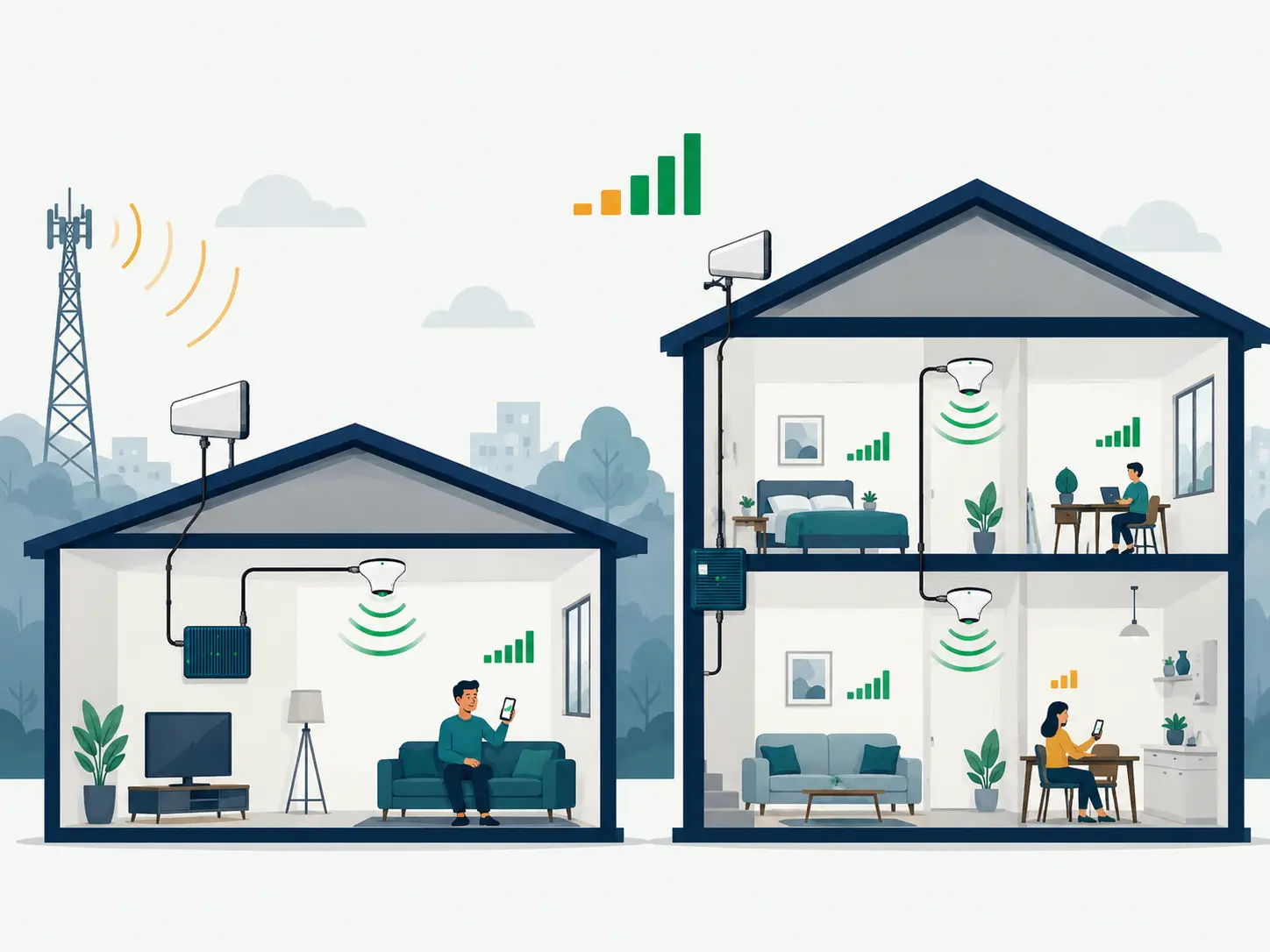
Buying a mobile signal booster without knowing what to look for is a common way to waste money — a unit that's the wrong size for your house, or built for the wrong network bands, often does almost nothing. This guide is written specifically to help you figure out what the best mobile signal booster for home use in Pakistan actually looks like for your specific situation, rather than pushing one particular product.
If you want the broader background first — what these devices are and how they work — we cover that in our complete guide to mobile signal boosters in Pakistan. This article goes a level deeper into the actual buying decision.
Why Mobile Signals Become Weak Inside Homes
Most homeowners assume weak indoor signal means their network operator has poor coverage in the area. Often that's not the real issue — the signal is fine outside, but doesn't survive the trip through the building's walls.
Common culprits in Pakistani homes include reinforced concrete walls and roofs, tinted or laminated glass windows, metal gates and grillwork near the signal path, and simply being further from the house's outer walls — bedrooms and storage rooms in the middle of a house are usually the weakest spots.
Do You Actually Need a Mobile Signal Booster?
Before spending on any equipment, it's worth confirming the problem is actually indoor signal loss and not a coverage gap. A signal booster is the right fix when your phone shows a reasonable signal (2–3 bars or more) just outside the house, but weakens noticeably once you're inside. If your phone struggles for signal even standing in the yard or on the roof, a booster has very little to work with, and the more relevant question becomes whether your operator has adequate coverage in your area at all.
How to Check Your Existing Outdoor Signal Before Buying
This step matters more than any spec sheet. Walk outside — ideally near the rooftop or the side of the house facing the nearest cell tower — and check your phone's signal bars for calls and mobile data separately. Try a phone call and a quick data test (loading a webpage or checking your data speed) rather than relying on the bar icon alone, since bar counts aren't always a precise measure. If outdoor signal is consistently weak in multiple spots around the house, a booster will have limited results, and it's worth checking with your operator about coverage in your area first.
How to Choose the Right Booster
Once you've confirmed there's a usable outdoor signal to work with, the actual buying decision comes down to a handful of practical factors.
Coverage Area
Manufacturers list a coverage area for each model, usually in square feet or square metres. Measure roughly how much indoor space actually needs better signal — a single bedroom is a very different job from an entire ground floor.
Supported Frequencies and Bands
This is the single most important technical factor, and the one most commonly overlooked. A booster only helps with the network generations and frequency bands it's built to support.
- 2G/GSM — still relevant for basic calls and SMS in some areas, though most users care more about data today.
- 3G — being phased down by some operators, but still in use in parts of Pakistan.
- 4G/LTE — the main driver of everyday mobile data speed for most households; this is usually the priority band to get right.
- 5G — still expanding in Pakistan and concentrated in specific urban areas; only relevant if your operator actually offers 5G where you live.
Confirm with your operator (or with us, if you're comparing models with GSM Repeater Store) which bands are actually active in your neighbourhood before choosing a booster — buying for bands your operator doesn't use locally is the most common way people end up disappointed.
Number of Rooms, Floors, and Users
A single indoor antenna can usually cover one room or a small open area well. Multiple rooms, especially across different floors, typically need either a stronger single system or a multi-antenna setup splitting the signal to more than one location. The number of people and devices actively using the signal at once (calls, video, browsing) also factors into whether a small residential unit is enough or whether you need a higher-capacity system.
Outdoor Signal Strength
As covered above, this is your starting point — the stronger and more consistent your outdoor signal, the better the results a booster can realistically deliver indoors.
4G vs 5G Signal Booster — Which One Should You Choose?
For most homes in Pakistan today, a 4G signal booster is the more practical choice, since 4G is what carries the bulk of everyday calls (over VoLTE) and data traffic for most operators. A 5G signal booster only makes sense if your operator has active 5G coverage in your specific area and you're already getting a 5G signal outdoors — otherwise there's simply no 5G signal for the booster to amplify indoors. If you're unsure which applies to you, checking your phone's network indicator outside the house (whether it shows 4G/LTE or 5G) is a quick way to tell.
Single-Story vs Double-Story Home: What Changes?
A single-story home is usually straightforward: one indoor antenna, centrally placed, often covers most of the usable indoor space. A double-story house typically needs either a higher-capacity single system with the indoor antenna positioned to reach both floors as evenly as possible, or a proper multi-antenna setup with coverage on each floor — especially if the ground and first floor are separated by a solid concrete slab, which blocks signal on its own.
How Much Does a Mobile Signal Booster Cost in Pakistan?
Prices vary significantly based on coverage area, the number of bands supported (a multi-band 2G/3G/4G unit costs more than a single-band one), build quality, and whether professional installation is included. Rather than quoting a single number that won't hold true across different models and setups, the more useful approach is to compare a few models against your actual requirements — coverage size, bands needed, and installation complexity — and request current pricing for those specific configurations. You can check current models and get a quote through our shop page.
Common Mistakes People Make When Buying a Signal Booster
- Buying the cheapest available option without checking which bands it supports
- Skipping the outdoor signal check, then blaming the booster when results are poor
- Underestimating coverage needs for a larger or multi-floor home
- Not confirming PTA Type Approval / compliance for the specific model before buying
- Placing the indoor antenna in a corner or behind furniture instead of a central, open position
Do Cheap Signal Boosters Really Work?
A lower price isn't automatically a problem — but it's worth being cautious of listings that don't clearly state which bands are supported, don't mention PTA compliance, or make broad claims like "works everywhere" or "boosts any signal to full bars." A genuinely suitable low-cost option for a single small room can work perfectly well; the risk is buying based on price alone without matching the unit to your actual bands and coverage needs.
Professional Installation vs DIY Installation
Simple, single-antenna residential setups are often manageable as a DIY installation if you're comfortable mounting an antenna and running a cable. Larger homes, multi-antenna systems, or installations requiring rooftop work benefit from professional installation — correct antenna placement and cable routing has a real impact on how well the system performs, and a poorly positioned outdoor antenna can undermine an otherwise good booster.
Jazz, Zong, Ufone and Telenor Compatibility
Compatibility depends on the specific frequency bands a booster supports matching the bands your operator uses in your area — this can vary by region even for the same operator. Rather than assuming a booster works with a given network, it's worth confirming band compatibility for your operator and location specifically before ordering.
Comparison: Coverage Needs by Home Type
| Coverage Need | Recommended Setup | Suitable For |
|---|---|---|
| Single room | Single-antenna, single or dual-band unit | Small house, one bedroom or home office |
| Full ground floor | Single higher-output antenna, centrally placed | Small to medium house, small shop |
| Whole double-story house | Multi-antenna system, one per floor | Double-story house, larger family home |
| Multiple rooms + reception area | Multi-antenna system with higher capacity | Office, clinic, small commercial space |
| Large property, weak outdoor signal | High-gain outdoor antenna + multi-antenna indoor setup | Rural or semi-rural home, farmhouse |
Frequently Asked Questions
What's the best mobile signal booster for a small home?
For a small home or apartment, a single-antenna unit supporting the bands your operator uses locally is usually sufficient — the priority is matching the bands, not necessarily buying the most powerful available unit.
Will a signal booster work in a double-story house with one unit?
Sometimes, if the indoor antenna is well-positioned and the floors aren't separated by especially dense construction — but many double-story homes get more consistent results from a multi-antenna setup covering each floor.
Do I need a 5G booster if my phone supports 5G?
Only if your operator actually has active 5G coverage reaching your outdoor area. A 5G-capable phone doesn't guarantee a 5G signal is present to boost.
Can one booster work for Jazz, Zong, Ufone and Telenor at the same time?
It depends on the model's supported bands and whether those bands overlap with each operator's bands in your area — this is worth confirming for your specific location rather than assuming.
How do I know if my problem is the building or the network itself?
Check your signal strength just outside the building. If it's reasonably strong outside but weak inside, it's most likely a building/indoor-coverage issue. If it's weak outside too, that points to a broader coverage issue in your area.
Final Buying Checklist
- Checked outdoor signal strength for calls and data separately
- Confirmed which bands your operator uses in your specific area (2G/3G/4G/5G)
- Measured the indoor area that actually needs coverage
- Decided between a single-antenna or multi-antenna setup based on home size and floors
- Confirmed PTA Type Approval / compliance for the model
- Decided whether DIY or professional installation makes sense for your setup
Conclusion
The "best" mobile signal booster for your home isn't a single specific model — it's whichever unit correctly matches your operator's bands, your home's size and layout, and the outdoor signal you're starting with. Getting those three things right matters far more than chasing the highest-spec unit on the market.
If you'd rather not work through all of this alone, message us on WhatsApp with your city, network operator, and roughly how many rooms or floors need coverage — we're happy to help you figure out which setup actually fits your home before you buy.
Have a Question About Your Signal?
Message us on WhatsApp with your city and network operator — we're happy to help.